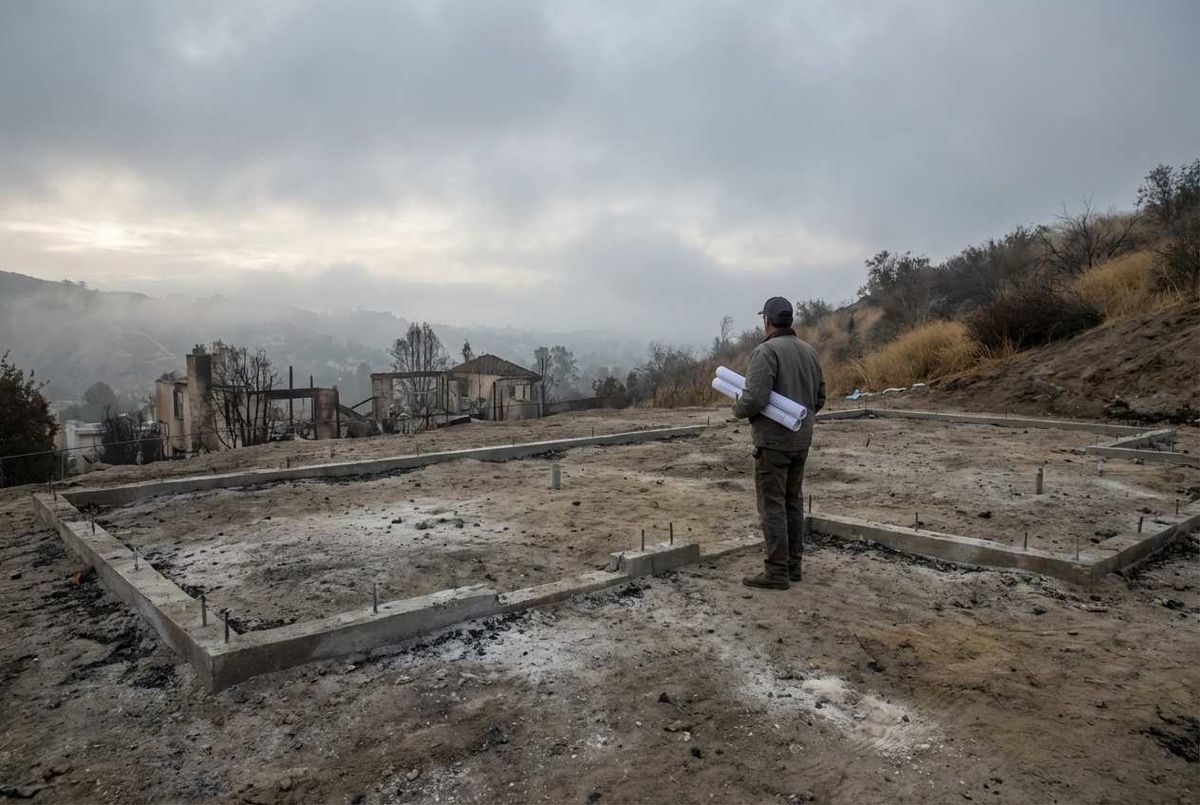
If you lost your home in the Eaton or Palisades fires, you've had more advice in the last few months than you can process. Insurance adjusters, public adjusters, contractors at the lot line, friends who read something online.
Most of it is well-intentioned. Very little of it comes with a clear explanation of sequence — which is what actually matters right now.
The rebuild process has a logic. When you understand the order, the decisions get easier and the timeline gets predictable.
Don't Sign Anything Yet
The first few months after a fire loss are when the most consequential mistakes get made. Not because homeowners are careless — because the pressure to act is intense and the people at your door are motivated to close quickly.
Contractors soliciting at the lot line. Public adjusters offering to maximize your claim for a percentage. Design-build firms asking for a letter of intent before you have a full picture of your insurance proceeds. The urgency they create is almost never real.
The exception: debris removal. That process has its own timeline driven by public health and county coordination, and insurance covers it in most cases. Engage with it. Understand your options — FEMA-coordinated removal versus private contractor. Don't let it lapse. Everything else can wait.
Know Your Insurance Position
Before a single design decision, know exactly what your policy covers.
Dwelling coverage is the number most people focus on. But several other components matter just as much.
Extended replacement cost. Many policies pay above the dwelling limit — typically 25–50% — if actual rebuild costs exceed the original estimate. Whether you have this, and how much, changes your budget ceiling.
Code upgrade coverage. Your original home met whatever code was in effect at the time. The replacement meets current code — Title 24 energy, current seismic, updated electrical. The cost difference is substantial. Good policies cover the gap.
Additional living expenses. This covers temporary housing during the rebuild. Duration and limits vary. If your timeline is 18–24 months, you need to know exactly how long your ALE runs.
Hire a licensed insurance attorney or independent claim consultant if your policy is complex or your carrier is slow. A public adjuster can help, but understand the fee structure — typically 10–15% of the claim — and make sure the math works before engaging one.
Get the Lot Ready
Debris removal is the physical prerequisite for everything that follows. Two paths in a coordinated fire event:
Government-coordinated (FEMA/CalOES/County). Free to eligible homeowners, cost billed to insurance. Slower. Removes the liability of managing hazardous material compliance yourself.
Private contractor. Faster in some cases. More expensive. You manage compliance with environmental and permitting requirements for ash, lead, asbestos, and other hazardous materials common in older residential construction.
Either way, the lot needs to be certified clean before permits can be submitted.
Choose Your Builder Before You Finalize Your Design
This is the step that surprises people, and the one that makes the biggest difference.
The conventional sequence: hire an architect, design the home, bid it out, pick a contractor, build. In the current LA environment — contractor capacity constrained, material lead times extended, LADBS permit timelines longer than pre-fire — that process creates problems.
Six to nine months into design with an architect, bids come back with no relationship to the budget you've been working from. Redesigns are expensive and demoralizing. The contractors available to bid may not be the ones you'd have chosen if you'd started earlier.
When designer and builder are the same team, budget accountability runs through the entire design process. Material and specification decisions happen with real cost data, not after the fact.
Design with the Rebuild, Not Against It
There's a temptation to rebuild exactly what was there. Same layout, same footage, same materials. It feels like the fastest path back to normal.
Sometimes that's the right answer. But the rebuild also presents an opportunity most homeowners, looking back, are glad they took: better insulated, better detailed, better adapted to the site, better equipped for the fire risk that defines this region going forward. Not larger. Not more expensive. Better.
What to Do Now
The families who move through this with the least friction found a builder early — before design was locked, before permits were filed — and that builder had done the full sequence before: design, permitting, pre-construction, build. A team that knows what's coming can sequence your decisions, protect your budget, and keep you from making permanent choices under temporary pressure.
Riley Projects is a Los Angeles design-build firm. We're working with families rebuilding in the Eaton and Palisades areas.